
 |
 |
 |
 |
 |
 |
Florida Lake Management For Golf Courses & HOA's
It’s important to understand what erosion restoration is, but it may be even more critical to find out ways to prevent it. Of course there are certain things mother nature will bring that are inevitable but we must do what we can to prevent devastation and destruction. In this case, prevent our shorelines from erosion and losing land. When erosion first starts to occur, the land loss is minimal in most cases and there is no sudden emergency for stopping it. However, it will inevitably worsen through time and eventually what was once only 6” of lost land, turns into 6’! Without Erosion Control properties that have such severe erosion that their home could potentially sink down. Erosion, being the cause of the reactions between wind and water, will eventually eat away at any shoreline but there are some things we can do to control erosion. The following are 7 steps that can be helpful in preventing soil erosion according to eHow.com: These steps are just some basic tips that can help better understand how to stabilize the soil. There are much more durable erosion control methods such as the Geotec Tube which not only returns your shoreline to its original state, but it prevents further erosion. Other Lake Managemen methods may include Preserve the rocks and vegetation which naturally occur along the shoreline. Vegetative/No Mow: This method involves encouraging or planting trees or woody shrubs for the soil binding properties of their large root
systems, grass and other herbaceous plants to protect against raindrop impact and scouring from surface runoff, or emergent aquatic
plants to stabilize bottom sediments and dampen wave action.
|
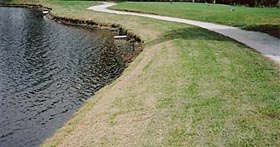
EROSION RESTORATION & EROSION CONTROL FOR YOUR SHORELINE
Providing Shoreline Erosion Control & Erosion Restoration Lake Management
Request An Erosion Control Estimate For your Shoreline Today
CALL FOR A FREE ESTIMATE: 1-888-753-7633
Erosion Control & Shoreline Erosion Repair in Florida Using Geotec Tube |
